Table of Contents
ToggleThen You Need To Know The Following Things First.
Starting with SEO can be intimidating, but these free and simple tips from the experts at The Brains will help you quickly grasp the key concepts of Search Engine Optimization.
SEO (Search Engine Optimization) may seem complex, and it’s understandable given its constantly evolving nature. Although the internet is relatively young in the grand scheme of things, SEO has already undergone significant changes. Interestingly, the principles of SEO predate the internet. One of its earliest forms was the Yellow Pages, where businesses competed to appear at the top of the directory to attract more customers.
Today, while the core principles of SEO remain the same, the techniques have evolved dramatically. With internet access more widespread than ever, the competition for online visibility is fierce. To secure a top spot in search results, businesses need to understand and implement effective SEO practices.
But why is it so important to rank high in search results? The answer is simple: the top result typically receives the most traffic. Search engines like Google are very selective about who ranks at the top, and achieving that number one position requires a well-thought-out SEO strategy.
The time has passed when businesses could manipulate their way to the top with tricks and shortcuts. Google has recognized these tactics and has established clear rules for ranking, ensuring a fairer playing field for everyone. Although these rules may seem challenging, understanding them makes mastering SEO much easier.
In this beginner’s guide to SEO, we will break down key tactics to help you understand best practices and prepare for your next SEO campaign. We will explore what search engines prioritize when determining rankings and how factors like competitor analysis and mobile optimization can play a crucial role in your success.
### Looking for Advanced Strategies? Check out our post on advanced SEO tactics!
What Is SEO and Why Is It Important?
If you’re already familiar with SEO, skip this section. However, here at The Brains, we believe it’s essential for everyone to understand the basics before diving into more advanced techniques.
In simple terms, SEO (Search Engine Optimization) is the process of improving your website’s visibility on search engines like Google. This includes strategies such as creating valuable content and building links. When working with an agency, one of the first steps is selecting the right keywords to optimize your content, including landing pages and blogs. This marks the beginning of a long but rewarding journey toward enhancing your site’s performance.
Once you have your keywords and content strategy in place, you will likely notice an increase in organic traffic, leads, and conversions. Link building is also crucial for boosting visibility and enhancing your website’s authority, signaling to Google that your site deserves to rank higher.
But SEO is not just about great content and links. Technical SEO is another vital aspect. It focuses on improving factors such as page speed and site structure to ensure your site is easy to navigate and free of errors. This can help reduce bounce rates and improve the user experience, which in turn boosts your rankings.
Additionally, depending on your business and target audience, you should consider both local and international SEO. Successfully ranking on a local and global scale can be a game-changer for your business’s success.
Ready to get started with SEO? Join The Brains today and elevate your website’s performance!
There are several other digital marketing strategies you can combine with SEO to enhance your online visibility. Whether it’s running a PPC campaign, using email marketing, or engaging on social media, optimizing your site across multiple channels will help expand your reach and ultimately increase your sales.
11 key SEO tips for beginners
**SEO Tip #1: Set Clear Goals Before You Start**
Establishing clear goals for your SEO strategy is essential. Every SEO campaign is unique, and it can provide various benefits to your business. Therefore, it’s important to identify what matters most to you.
While it may be tempting to create a campaign solely focused on boosting organic traffic, remember that the ultimate goal is conversions—these could be sales, sign-ups, downloads, video views, or contact form submissions. If your traffic doesn’t lead to these actions, your SEO efforts will not yield a strong ROI, leaving you with only vanity metrics.
Once you clearly define what you want to achieve, you’ll be on the right path to SEO success!
**SEO Tip #2: Utilize Google Analytics, Lighthouse, and Search Console to Monitor and Optimize Website Performance**
Tracking the success of your SEO strategy relies heavily on data. Google provides powerful, free tools that make it easy to monitor key metrics and assess your website’s performance.
Google Analytics is essential for any SEO campaign. This user-friendly platform allows you to track critical metrics such as overall traffic, bounce rate (the percentage of visitors who leave without engaging with your content), and conversions. Setting it up is straightforward, and your website development team can assist you in linking it to your site.
Another crucial tool is Google Search Console. This free resource helps you monitor your website’s performance, track important updates, and make data-driven decisions for your next SEO move. It’s simple to set up and can be managed by your development or technical SEO team, but it’s a good idea to check it regularly to stay updated on your SEO progress.
For more in-depth insights, Google Lighthouse is an excellent tool. This simple browser extension generates detailed reports on your website’s speed, stability, and accessibility for both desktop and mobile visitors. It offers actionable insights to help you improve your website’s performance, which can enhance your rankings and user experience.
From the beginning, ensure that Google Analytics is set up correctly and monitor it closely. Use Google Analytics and Search Console for detailed insights into user behavior, top-performing content, bounce rates, and conversion rates. By combining this data with insights from Lighthouse, you’ll be able to adjust and enhance your SEO strategy for better results.

**SEO Tip #3: Choose the Right Keywords**
Solid keyword research is the cornerstone of any successful SEO strategy. Keywords are the terms people enter into search engines when looking for information. By optimizing your website for the right keywords, you signal to Google that your pages are relevant and should appear among the top results for those searches.
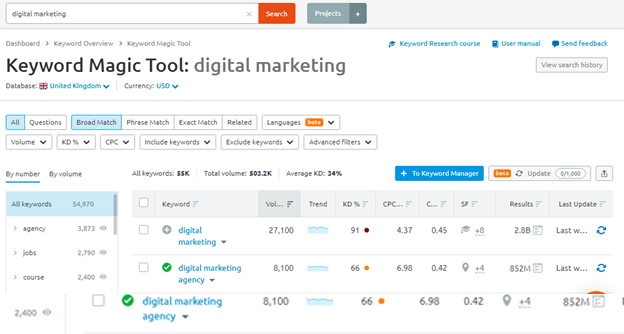
Think of keyword optimization as a way of telling Google exactly what your website is about and how it connects to the queries people are making. To claim that coveted number-one spot on Google, you first need to identify the keywords that will help you get there!
The SEMrush Keyword Magic Tool is an excellent resource for uncovering keywords related to your service that you may not have considered. It provides valuable data such as search volume, keyword difficulty (KD—how challenging it is to rank for a term), and even insights into SERP features. SERP features are non-traditional results on the search engine results pages, such as images, local listings, or knowledge panels, which can give your site more visibility beyond standard organic results.

SEMrush also allows you to track the performance of your selected keywords, helping you monitor their visibility and estimated traffic. You can view search volumes and CPC (cost per click) data, giving you a better understanding of how competitive these terms are.
If you’re new to SEO and unsure which keywords to target, consider using keyword research tools like SEMrush or Ahrefs. Both platforms offer detailed keyword exploration tools that provide crucial data on keyword difficulty and search volume, helping you make informed decisions.
SEO keyword rankings can be highly competitive, especially if you lack SEO expertise or if search engines like Google haven’t yet deemed your site worthy of a top spot. Therefore, it’s important to manage your expectations—getting to the first page of Google can be challenging!
Here are a few key factors to consider when choosing which keywords to target:
**Short-Tail vs. Long-Tail Keywords**
When selecting keywords for your SEO strategy, it’s important to understand the difference between short-tail and long-tail keywords. Short-tail keywords are typically 1-3 words long and tend to have high search volume and competition. These broad terms can be harder to rank for because many websites are targeting them.
Long-tail keywords are longer, more specific phrases. While they usually have lower search volumes and less competition, they’re often more valuable. Users searching for long-tail keywords are typically closer to making a purchase, which can lead to a higher return on investment (ROI).
For example, if you’re a business in software engineering, trying to rank for the term “software developer” will be tough due to its high competition. Currently, “software engineering” has a keyword difficulty of 81% and a global search volume of 8.1k on SEMrush, making it challenging to rank for.
Instead, consider targeting a long-tail keyword like “software development company.” This has a lower keyword difficulty of 56% and a search volume of 880. It’s more specific, making it easier to rank for while still being relevant to your target audience.
Let’s take another example: If you sell socks online, ranking for the keyword “socks” is nearly impossible due to heavy competition from big brands. However, by targeting “buy novelty men’s socks online,” you’ll have a much better chance of ranking on Google’s first page—and you’ll be reaching customers who are ready to make a purchase.
Before starting an SEO campaign, consider both short-tail and long-tail keywords. Think about which ones you have the best chance of ranking for. If you need guidance, our SEO experts are here to help you choose the best keywords for your business.
**LSI Keywords**
LSI (Latent Semantic Indexing) keywords are crucial for providing context to your content and improving your chances of ranking. These keywords help search engines understand the true meaning behind your content. For example, if you’re writing a post with the keyword “Apple,” LSI keywords can help Google determine whether you’re referring to the tech company or the fruit.
LSI keywords provide context that assists search engines in accurately interpreting the intent of your content. This ensures your blog posts or service pages are shown to the right audience—people who are looking for exactly what you offer.
If you’re looking for LSI keywords, an LSI generator tool is a great resource for finding relevant terms. Strategically using these keywords in your content can enhance your SEO and help you rank higher.
### SEO Tip #4: Analyze Your Competition
Understanding your competition and knowing your position in comparison to them is one of the most effective SEO tactics for beginners. Competitor analysis provides valuable insights into what you need to do to maintain or achieve a top spot on search engine results pages (SERPs).
#### Key Benefits of Competitor Analysis:
- **Identify Weaknesses**: Discover areas where your competitors are lacking, allowing you to seize opportunities.
- **Leverage Strengths**: Examine your competitors’ successful tactics and implement similar strategies on your own site.
- **Discover Market Gaps**: Find keywords or topics that your competitors are not addressing, giving you a competitive edge.
- **Create a Clear Strategy**: Understand the necessary steps to outperform your competitors and claim the number one spot.
While we could elaborate extensively on competitor analysis, let’s break down some of the best ways to assess your competitors’ strengths and weaknesses and adapt your SEO strategy accordingly:
– **Study Backlinks**: Backlinks are crucial for SEO, as they are links from other websites that point to yours. Search engines like Google consider the quality and quantity of backlinks when determining rankings. By analyzing your competitors’ backlinks, you can identify opportunities to earn high-quality links and improve your own SEO.
– **Analyze Organic Keywords**: Check which keywords your competitors are targeting. This will provide insight into their SEO strategy and reveal areas where you can compete directly or discover gaps they’ve overlooked.
– **Evaluate Content Quality**: Google prioritizes well-written, useful content over keyword-stuffed pages. Review your competitors’ content to see if they’re providing real value. If they are successful, you can adjust your own content strategy to offer even more relevant and useful information.
– **Review PPC Ads**: If your competitors run paid search ads, take note of their ad copy. Pay attention to their use of calls-to-action (CTAs) and persuasive language. This can inform your own page titles, meta descriptions, and ad copy to improve click-through rates.
– **Analyze Local SEO**: If you’re a local business, examine your competitors’ local SEO efforts. Check if they’re using local keywords or targeting specific geographic areas. Google tends to rank businesses higher in local searches, so understanding how local competitors optimize their sites is crucial.
Remember, competitor analysis isn’t a one-time task—it’s an ongoing process. To stay ahead in search engine rankings, continually monitor your competitors and refine your SEO strategy accordingly!
**SEO Tip #5: Make Your Website Mobile-Friendly**
When building or updating your website, it’s crucial to ensure that it is mobile-friendly. Studies show that up to 55% of internet browsing now occurs on mobile devices, making mobile optimization essential for boosting traffic. This is especially important for e-commerce sites, where over 65% of online purchases are made via mobile devices.
Search engines like Google and Bing recognize this shift and have incorporated mobile-friendliness into their ranking algorithms (you can learn more about this in our blog on Google’s Core Web Vitals). Consequently, many companies are adopting a “mobile-first” approach, prioritizing mobile usability in their website design.
To remain competitive and improve your SEO rankings, ensure your website is fully optimized for mobile use! While you’re here, take a look at our post on how to increase traffic to your website. If you’ve ever wondered, “Why isn’t my website getting any traffic?” we’ll guide you through strategies to enhance your visibility and attract more visitors to your site!
**SEO Tip #6: Invest in Technical SEO**
Technical SEO focuses on optimizing the technical aspects of your website to enhance its performance, stability, and accessibility across devices. This includes making improvements that help your site load faster, function more smoothly, and be easily crawled by search engines. Technical SEO often requires specialized skills, as many tasks involve making changes to website code, updating plugins, or improving design elements. These adjustments can significantly impact your site’s search engine rankings and are crucial for a successful SEO strategy.
If you’re new to SEO, the technical side may seem overwhelming. Terms like HTTPS, page load speed, and HTML tags can sound complicated at first, but don’t be discouraged. Even seasoned SEO experts can find technical SEO challenging.
Mastering technical SEO often takes time and practice. You’ll need to learn how to manage broken and internal links, optimize XML sitemaps, and more. If you’re serious about improving your website’s SEO performance, it’s worth investing in professional technical SEO support.
At The Brains, our in-house technical SEO team has decades of experience conducting technical SEO audits that help businesses significantly improve their search engine rankings. If you’re ready to elevate your website, get in touch with one of our technical SEO experts today!
**SEO Tip #7: Stay Updated with the Latest SEO Tactics, Tips, and News**
Creating high-quality content, staying ahead of your competitors, and investing in technical SEO are all essential components of an effective SEO strategy. However, it’s important to remember that what worked yesterday may not be effective today. Search engines like Google continually update their algorithms to enhance user experience, so staying informed about these changes is crucial.
The challenge is that there is no guaranteed way to predict what Google will do next. While SEO experts and blogs can provide educated guesses, planning your SEO strategy can still be difficult due to the unpredictability of these updates.
One aspect that remains constant is Google’s commitment to user experience. If there’s one principle you can rely on, it’s that search engines will always prioritize delivering a positive experience for users when determining their rankings. Therefore, ensuring that your site provides excellent usability, fast load times, and relevant, engaging content is always a safe strategy.

**SEO Tip #8: Understand Your Target Audience**
At Brains, we believe that understanding your target audience is fundamental to the success of any SEO campaign. Without an awareness of who your audience is and what motivates them, your efforts may not generate the leads or sales you desire.
Before implementing any SEO strategy, it’s crucial to ask yourself important questions about your audience:
– Who are they?
– What motivates them to make a purchase?
– What is their age?
– Where are they located?
– What are their interests?
– What is their budget?
By answering these questions, you can develop a focused SEO campaign that maximizes your return on investment (ROI). At The Brains, we utilize our unique Brainy Formula, which combines insights from buying psychology and industry data to deliver results-driven campaigns. This approach allows us to create campaigns tailored to individuals most likely to make a purchase, ensuring that your SEO efforts reach the right audience at the right time.
**SEO Tip #9: Create a High-Quality User Experience (UX)**
In 2024, enhancing user experience (UX) is one of the most important SEO tactics for improving your website’s ranking and driving organic traffic. Google places a significant emphasis on UX, as do your website visitors—especially if you aim to convert traffic into sales. A smooth, intuitive user experience can make a big difference in keeping visitors on your site and encouraging them to take action. Here are some of the best ways to improve your website’s user experience and boost your SEO rankings:
- **Improve Page Load Speed**
Slow-loading pages can frustrate users and lead to high bounce rates. Google prioritizes fast-loading websites, so optimizing your page speed is crucial for both UX and SEO. Use tools like Google Page Speed Insights to identify areas for improvement.
- **Mobile Optimization**
With more than half of internet browsing occurring on mobile devices, your site must be fully optimized for mobile users. Google uses mobile-first indexing, meaning it prioritizes the mobile version of your site for rankings. Ensure your site is responsive and loads quickly on mobile devices.
- 3. **Simplify Navigation**
Clear, intuitive navigation is essential for a good user experience. Users should be able to find what they are looking for easily. Streamline your menus and create a logical, user-friendly site structure to improve UX and encourage visitors to stay longer.
- **High-Quality Content**
Content is still king in SEO. Provide valuable, well-structured content that addresses users’ needs. Use headings, bullet points, and multimedia to make your content easy to scan and digest. Ensure that your content is both informative and engaging to boost dwell time.
- **Clear Calls to Action (CTAs)**
Ensure that your CTAs are prominent and guide users toward your desired actions, whether it’s making a purchase, signing up for a newsletter, or contacting you for more information. CTAs should be easy to spot and strategically placed across your website.
- **Fix Broken Links and Errors**
Broken links or 404 errors can frustrate users and impact your rankings. Regularly audit your site for any broken links and fix them promptly. A seamless, error-free experience is key to user satisfaction and SEO.
- 7. **Use High-Quality Visuals**
Clear, high-quality images and videos enhance UX, making your content more engaging and visually appealing. Ensure that your images are optimized for fast loading times and relevant to the content on the page.
- **Ensure Accessibility**
An accessible website can improve UX for all users, including those with disabilities. Use accessible design elements, like clear font sizes, alt text for images, and appropriate color contrast, to ensure your site is usable by everyone.
- 9. **Enhance Security**
Security is an essential part of UX. Websites with HTTPS encryption are considered more secure and trustworthy by both users and search engines. Make sure your site is secure to increase user confidence and improve SEO rankings.
By prioritizing these user experience improvements, you’ll not only provide better service to your visitors but also enhance your SEO rankings and organic traffic in 2024.

**SEO Tip #10: Improve Your Site Speed**
As you probably know, patience is running thin when it comes to website visitors. If your site doesn’t load quickly enough, they won’t hesitate to leave and find what they need elsewhere. On average, users will bounce after about 3 seconds of waiting for a page to load. Therefore, it’s crucial to get everything up and running within that time frame.
To check your site speed, use tools like Test My Site to gain insights into how long it takes for your website to load, both on desktop and mobile devices.
**Common Causes of Slow Site Speed Include:**
– **Poor Web Hosting:** If your hosting provider is slow or unreliable, it will impact your website’s load times. Choose a reputable hosting service with fast servers to ensure quick access for users.
– **Large, Unoptimized Image Files:** High-quality images are essential, but oversized images can significantly slow down page loading times. Ensure your images are compressed without compromising quality.
– **Unnecessary Code:** Excess code, such as unused JavaScript or CSS files, can also drag down download speeds. Regularly clean up your code to ensure it’s as efficient as possible.
– **Unoptimized Ads:** Ads that aren’t optimized for your site can consume resources and slow down page performance. Ensure your ads load smoothly without affecting overall speed.
By addressing these common issues, you can enhance your site’s speed, improve user experience, and boost your SEO rankings.
**SEO Tip #11: Create Content That is Informative, Digestible, and Easy to Read on Mobile**
Creating content that is both valuable to the reader and optimized for SEO is a delicate balancing act. To succeed, you need to craft content that is not only engaging and informative but also strategically designed to rank well on search engines.
The key is to develop laser-focused content that addresses the specific needs and questions of your target audience. While doing this, be sure to naturally incorporate semantic keywords and phrases to improve your content’s visibility and relevance in search results.
**Natural, Authentic Writing**
While keywords are important, they shouldn’t dominate your content or make it feel forced or overly sales-driven. Remember, you are writing for real people, not just search engine crawlers. Your goal should be to engage and connect with your audience, showing them why your business is the best choice compared to competitors.
Google is becoming increasingly sophisticated, prioritizing content that is engaging and genuinely helpful over content that is simply optimized for search engines. If your content doesn’t resonate with readers, they will quickly return to the search results, which can negatively impact your bounce rate.
Focus on writing primarily for your audience. When you provide real value and establish a connection with people, your rankings will improve naturally. Keep in mind that your content is about communication with another person, not just appealing to algorithms.
Are you looking for more content tips? Check out our guide on how to create an effective content marketing funnel. It’s filled with strategies to help you attract, engage, and convert your audience at every stage of their journey!
